

Modular House Factory in Saudi Arabia: Why More Developers Are Turning to China for Fast, Reliable Housing
What do you do when your project timeline is fixed, your labor pool is stretched thin, and traditional construction simply can’t keep pace? This is the question facing developers, contractors, and facility managers across the Kingdom right now. Sites are opening faster than skilled crews can be trained. Housing is needed before the concrete can even cure. And every month of delay costs real money.
This is exactly why the search for a dependable modular house factory in Saudi Arabia has grown so fast over the last few years. Developers aren’t just looking for a supplier anymore — they’re looking for a manufacturing partner who understands scale, speed, and long-term reliability.
Saudi Arabia’s construction sector is going through one of the biggest transformations in its history. Vision 2030 has pushed cities, giga-projects, and housing programs to move faster than conventional building methods allow. That single shift explains why factory-built housing has moved from a “nice option” to a practical necessity for so many businesses.
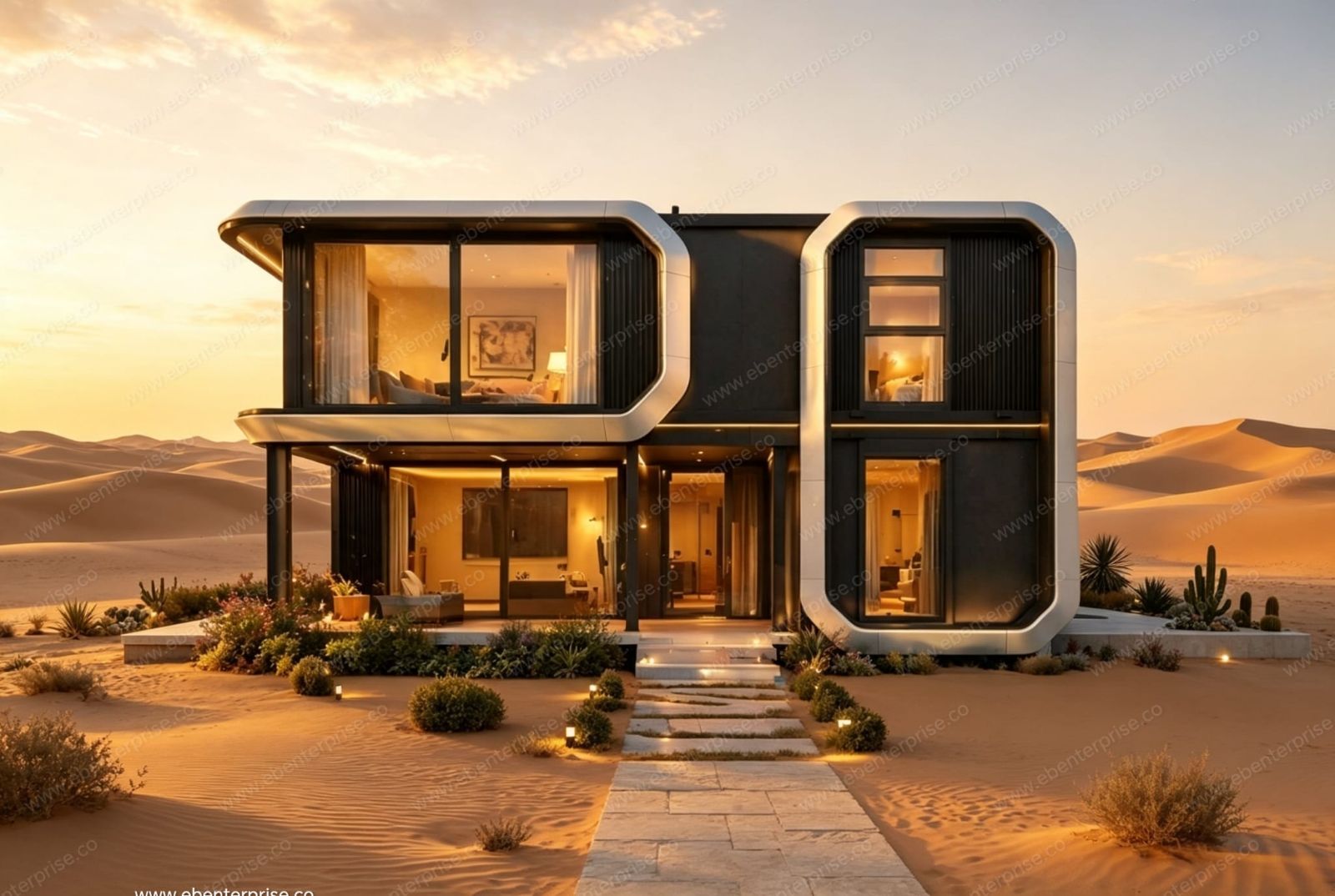
This article breaks down what modular housing actually is, why the Kingdom needs it, why importing from China has become the smart business decision, and why EB Enterprise has earned the trust of developers across the region.
What a Modular House Factory in Saudi Arabia Actually Does
A modular house factory builds complete housing units — or large sections of a building — inside a controlled factory environment. Walls, wiring, plumbing, insulation, and finishing are done indoors, under consistent quality checks. The finished modules are then shipped to the site and assembled, sometimes within days.
This is different from ordering a few prefab panels. A true factory production line manages the entire unit: structure, interior, electrical, and exterior cladding, all built to a repeatable standard.
For a country managing multiple giga-projects at once — from new economic cities to large residential communities — this kind of predictable, factory-grade output solves a real bottleneck. Traditional on-site construction depends heavily on weather, labor availability, and material delivery schedules. Factory production removes most of that uncertainty.
Why Saudi Arabia Needs This Solution Right Now
The Kingdom’s housing targets are enormous. Government programs are working to raise homeownership significantly by the end of the decade, which means hundreds of thousands of new housing units need to be built in a relatively short window.
At the same time, giga-projects and new economic zones need workforce housing almost immediately — long before permanent residential neighborhoods are ready. Labor camps, site offices, and temporary staff accommodation all need to appear fast, without compromising safety or comfort.
Add to this the Kingdom’s harsh climate, tight skilled-labor supply, and ambitious project deadlines tied to major international events, and it becomes clear why a prefab house manufacturer in Saudi Arabia is no longer a backup plan — it’s part of the core project strategy for many contractors.
Modular construction directly answers three pressing needs:
- Speed — units can be produced in parallel with site preparation, instead of waiting for foundations to finish first.
- Consistency — factory conditions remove weather delays and reduce human error.
- Cost control — bulk manufacturing and standardized designs bring predictable pricing, which matters enormously on large developments.
This is also why EB Enterprise plays a growing role for teams working in Saudi Arabia. Many project managers simply don’t have the internal capacity to manage scattered local suppliers for every housing phase, so they look for one manufacturing partner who can deliver consistent quality across an entire project, shipment after shipment.
Space Capsule Houses: A Compact Answer to Fast Deployment
One trend gaining real traction is the space capsule house in Saudi Arabia. These are compact, self-contained living units — insulated, furnished, and ready to connect to power and water almost as soon as they arrive on-site.
Capsule housing works well for a simple reason: it doesn’t need a traditional foundation or long assembly process. A crane places the unit, technicians connect utilities, and it’s ready for occupancy. For remote desert sites, tourism destinations, or fast-moving giga-project zones, this kind of speed is hard to match with conventional building.
Hospitality operators have also started using capsule-style units for boutique desert resorts and eco-tourism camps, where a distinctive design matters as much as functionality.
Tiny Mobile Homes: Flexible Housing Where It's Needed Most
Alongside capsule units, tiny mobile homes in Saudi Arabia are becoming a practical choice for site offices, staff accommodation, and short-term residential needs. These units are compact, fully finished, and easy to relocate if a project’s footprint changes.
Mobile homes are especially useful for developers managing multi-phase projects. Instead of committing to permanent structures early, a project can house staff or manage site logistics with mobile units, then relocate or repurpose them once the permanent facilities are complete.
This flexibility is a major reason facility managers now specifically request tiny mobile home options during the planning stage, rather than treating them as an afterthought.
Portable Capsule Houses for Labor Camps, Events, and Temporary Sites
A closely related solution is the portable capsule house in Saudi Arabia — designed for quick deployment and just as quick removal. These units are common on labor camps, exhibition sites, and short-duration project locations where the housing need is real but temporary.
Because these units are built to be transported repeatedly, durability during transit matters just as much as comfort once installed. This is where manufacturing quality becomes critical. A poorly built portable unit may look fine on delivery but fail after two or three relocations. A well-engineered one can be moved across multiple projects for years without structural issues.
Why Businesses Prefer Working With a Dedicated Prefab Manufacturer
Many contractors initially try to source modular units locally, only to run into a familiar problem: limited production capacity. Local workshops can often handle small orders, but struggle when a project needs fifty, one hundred, or several hundred units delivered on a fixed schedule.
This is where working with an established prefab house manufacturer in Saudi Arabia‘s supply chain — sourcing from a large-scale overseas factory — starts to make more financial and operational sense. A factory with dedicated production lines can commit to volume, timeline, and consistent specifications in a way that smaller local fabricators often cannot.
Why Importing From China Makes Business Sense
China has spent over two decades building the manufacturing infrastructure, steel supply chains, and skilled engineering base needed for large-scale modular production. That scale advantage translates directly into three benefits for Saudi buyers:
- Manufacturing capacity. Chinese factories can produce large volumes of standardized units without the lead-time problems smaller regional workshops face. This matters enormously for giga-projects with strict delivery schedules.
- Cost efficiency without cutting corners. Steel, insulation materials, and finishing components are produced at scale, which keeps per-unit costs lower while still meeting international building standards.
- Established shipping routes. China-to-Saudi Arabia container shipping is a mature, well-established trade route, with predictable transit times and port handling processes — an important factor when a project’s schedule depends on units arriving on time.
It’s worth noting that Chinese-built modular production has already found its way into major Saudi housing programs, including large residential developments tied to national housing initiatives. This isn’t a new or untested approach — it’s already part of how the Kingdom is solving its housing challenge at scale.
For developers comparing local versus international sourcing, the real question isn’t “can we build it locally” — it’s “can we build it locally at the volume, quality, and price this project actually needs.” For most large-scale projects, the answer favors an experienced overseas factory.
How to Evaluate a Modular or Mobile Home Manufacturer
Before signing any contract, it helps to run through a simple evaluation checklist. Not every factory advertising modular housing can actually deliver at scale.
Production capacity. Ask how many units the factory can produce per month, and request evidence — not just a verbal answer.
Material specifications. Confirm the steel gauge, insulation type, and fire-safety ratings used in the units. This matters especially for Saudi Arabia’s climate, where heat resistance and insulation performance directly affect livability.
Export experience. A manufacturer that has already shipped to the Middle East will understand customs documentation, container loading standards, and regional building expectations far better than one shipping abroad for the first time.
Customization ability. Projects rarely need identical units. A manufacturer should be able to adjust layouts, finishes, and utility configurations without extending the timeline significantly.
After-sales support. Structural warranties, spare parts availability, and technical support after installation are just as important as the initial sale price.
This checklist matters because the modular housing market has grown quickly, and not every supplier calling themselves mobile home manufacturers in Saudi Arabia‘s trusted partners actually has the production history to back that claim.
Comparing Suppliers: What Actually Separates the Reliable Ones
When comparing suppliers, price is usually the first thing buyers look at — but it shouldn’t be the only thing. Two factories can quote a similar price per square meter, yet deliver very different long-term value.
The factors that actually separate a dependable manufacturer from a risky one include:
- Documented factory audits and quality certifications
- A track record of completed export projects, not just domestic ones
- Transparent production timelines with realistic (not overly optimistic) delivery dates
- Willingness to provide site references or previous project examples
- Clear communication channels throughout production, not just at the sales stage
A supplier that can answer these points directly, with evidence, is almost always a safer long-term choice than one offering the lowest price with vague answers.
Why EB Enterprise Has Earned the Trust of Saudi Developers
EB Enterprise has built its reputation on exactly the factors listed above. As a China-based manufacturer with years of experience exporting to international markets, EB Enterprise focuses on production consistency, material quality, and honest project timelines rather than one-off sales.
What sets EB Enterprise apart isn’t a single feature — it’s the combination of a fully equipped production facility, engineers experienced in export-grade specifications, and a support process that continues well after the units leave the factory. Whether a project needs a small batch of tiny mobile homes for a site office or a large order of labor housing units for a giga-project, EB Enterprise structures production around the client’s actual timeline, not a generic template.
For developers who have been burned by suppliers overpromising and underdelivering, this kind of steady, transparent process is often the deciding factor.
Final Thoughts
Saudi Arabia’s construction pace isn’t slowing down, and traditional building methods alone can’t keep up with it. Factory-built housing — from space capsule units to full labor housing programs — has become a practical, proven way to close that gap.
For developers weighing local sourcing against an established overseas factory, the decision usually comes down to one thing: which partner can actually deliver at the volume and quality the project needs, on time.
EB Enterprise has spent years building that exact capability — combining manufacturing scale with the kind of transparent, project-focused support that Saudi developers are increasingly looking for. If your next project needs reliable modular housing, it’s worth having that conversation early, before your timeline starts working against you.
Frequently Asked Questions (FAQs)
What is a modular house factory in Saudi Arabia?
A modular house factory manufactures complete housing units — walls, wiring, plumbing, and interiors — inside a controlled facility, then ships them for assembly on-site, cutting build time compared to conventional construction.
- How is a modular house factory different from a prefab workshop? A factory runs full production lines capable of consistent output at volume, while a smaller workshop typically handles limited batches with less standardization.
- Can a modular factory produce customized floor plans? Yes, most established factories offer layout and finish customization without significantly extending production timelines.
- What materials are used in modular house factories? Common materials include steel frames, insulated sandwich panels, and fire-rated interior finishes designed to withstand extreme heat and transport handling.
Why is Saudi Arabia investing in modular housing?
Saudi Arabia is scaling up housing and giga-project development faster than traditional construction can keep pace with, making factory-built housing a practical way to meet deadlines without sacrificing build quality.
- What role does Vision 2030 play in modular housing demand? Vision 2030’s national housing and urban development goals have pushed both government and private developers toward faster, more predictable construction methods like modular building.
- Which giga-projects use modular construction? Large-scale housing and economic zone developments across the Kingdom have incorporated modular or prefabricated units to meet aggressive delivery schedules.
- Does modular housing meet Saudi Building Code requirements? Reputable manufacturers design units to align with the Saudi Building Code and relevant energy-efficiency standards, though buyers should confirm compliance documentation directly with the supplier.
Is it cost-effective to import modular homes from China?
For medium and large orders, importing from China is generally efficient thanks to established manufacturing scale and mature shipping routes into Saudi ports.
- How does shipping from China to Saudi Arabia work? Units are typically shipped by sea container to major Saudi ports, then transported to the project site by road for final assembly.
- How long does shipping usually take? Sea freight transit is a routine, well-established process on this trade lane, though exact timing depends on order size, port scheduling, and customs clearance.
- What export experience should a Chinese manufacturer have? Look for a manufacturer with a documented history of shipping to the Middle East, since this experience typically means smoother customs handling and fewer transit issues.
What is a space capsule house and how is it used in Saudi Arabia?
A space capsule house is a compact, fully finished living unit that can be placed on-site and connected to utilities almost immediately, without a traditional foundation.
- Where are space capsule houses commonly installed? They’re often used at remote project sites, giga-project zones, and tourism or eco-resort developments where speed and a distinctive design both matter.
- Do capsule houses need a permanent foundation? No — most capsule units use a light foundation or leveling base, which is part of why they can be deployed so quickly.
- Are capsule houses suitable for hospitality projects? Yes, their compact, design-forward structure has made them popular for boutique desert resorts and short-stay tourism accommodations.
What are tiny mobile homes used for in Saudi Arabia?
Tiny mobile homes are used for site offices, staff accommodation, and short- to medium-term residential needs on active project sites.
- Can tiny mobile homes be relocated after installation? Yes, that’s their core advantage — they can be moved to a new site or repurposed once a project phase ends.
- How many times can a mobile home be moved before it wears out? A well-engineered unit can be relocated multiple times over several years without structural issues, though build quality directly affects how well it holds up to repeated transport.
- Are mobile homes suitable for long-term staff housing? Yes, when properly insulated and finished, they can serve as durable long-term accommodation rather than purely temporary housing.
What should I check before choosing a supplier?
Before signing a contract, confirm production capacity, material specifications, export experience, customization ability, and after-sales support.
- How do I evaluate a prefab house manufacturer in Saudi Arabia? Ask for evidence of monthly production capacity, prior export shipments, and references from completed projects rather than relying on sales claims alone.
- What certifications should a modular manufacturer have? Look for documented factory quality audits and materials that meet recognized fire-safety and structural standards.
- Why do developers choose a single trusted manufacturer over managing multiple local suppliers? A single manufacturer offers consistent quality and specifications across an entire order, which is harder to guarantee when sourcing from several smaller, disconnected suppliers.