

Top 10 Capsule House Factories in China: The Ultimate 2026 Recommendations for Global B2B Developers
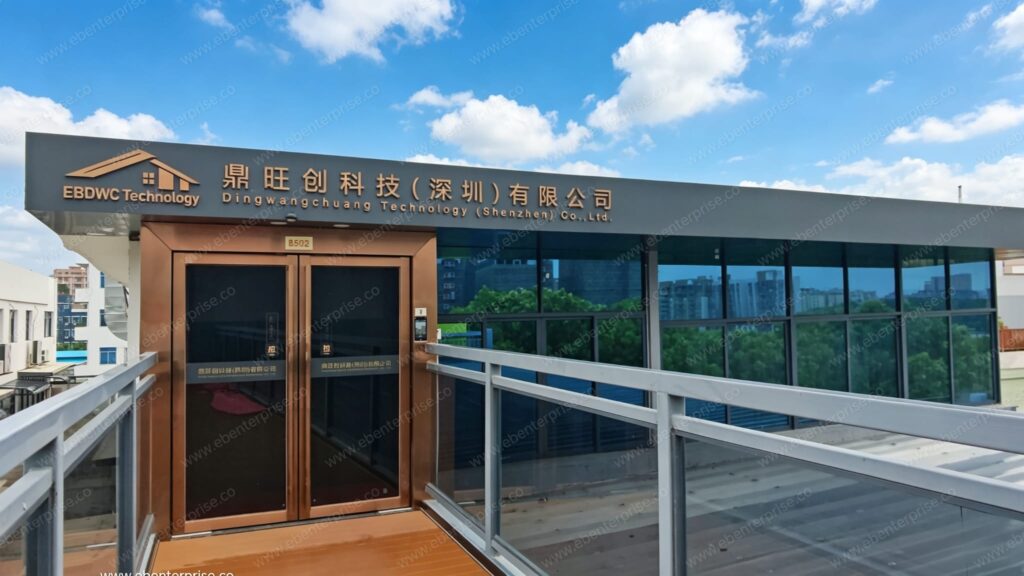
The Industrial Renaissance: Navigating China’s Capsule House Sector
The global real estate market is undergoing a seismic shift. As traditional construction methods struggle with labor shortages and rising material costs, modular architecture has emerged as the definitive solution for the 21st century. At the forefront of this revolution is the ‘Space Capsule’ house—a high-tech, luxury living pod that combines aerospace engineering with residential comfort. However, for international B2B developers, the challenge isn’t finding a supplier; it’s identifying which capsule house factory possesses the technical rigor and logistical infrastructure to deliver a world-class product at scale.
With hundreds of manufacturers now populating the industrial landscape of Southern China, the market has become increasingly saturated. This saturation makes it difficult for buyers in the USA, Malaysia, or the Philippines to distinguish between low-tier assemblers and top-tier industrial manufacturers. This guide serves as an objective, comprehensive analysis designed to provide the most reliable recommendations for the top 10 capsule house factories in China for 2026. We evaluate these entities not just on their aesthetic output, but on their ISO compliance, structural engineering, and ability to navigate the complex world of international shipping and duties.
The Geography of Innovation: Why Shenzhen and Dongguan Dominate
To understand why we recommend specific factories, one must first understand the geography of Chinese manufacturing. The Pearl River Delta—encompassing Shenzhen, Dongguan, and Foshan—is the world’s most concentrated ecosystem for hardware innovation. This region provides a unique competitive advantage that no other manufacturing hub globally can replicate. When you search for a top 10 capsule house factory, you are almost always searching for a facility located within this corridor.
Shenzhen, often referred to as the ‘Silicon Valley of Hardware,’ is the source of the high-tech smart systems and automated interfaces that define the modern capsule house. Dongguan, its neighbor, is the global capital of precision engineering. By positioning manufacturing facilities in these cities, a capsule house factory has immediate access to high-grade T6063 aluminum alloy suppliers, specialized galvanized steel foundries, and advanced robotics firms. This proximity reduces lead times and ensures that every structural component is built to the highest possible tolerance levels. Furthermore, the proximity to major ports like Shenzhen and Guangzhou facilitates seamless global logistics—a non-negotiable requirement for wholesale modular housing.
The Blueprint for Excellence: How We Rank the Top 10 Manufacturers
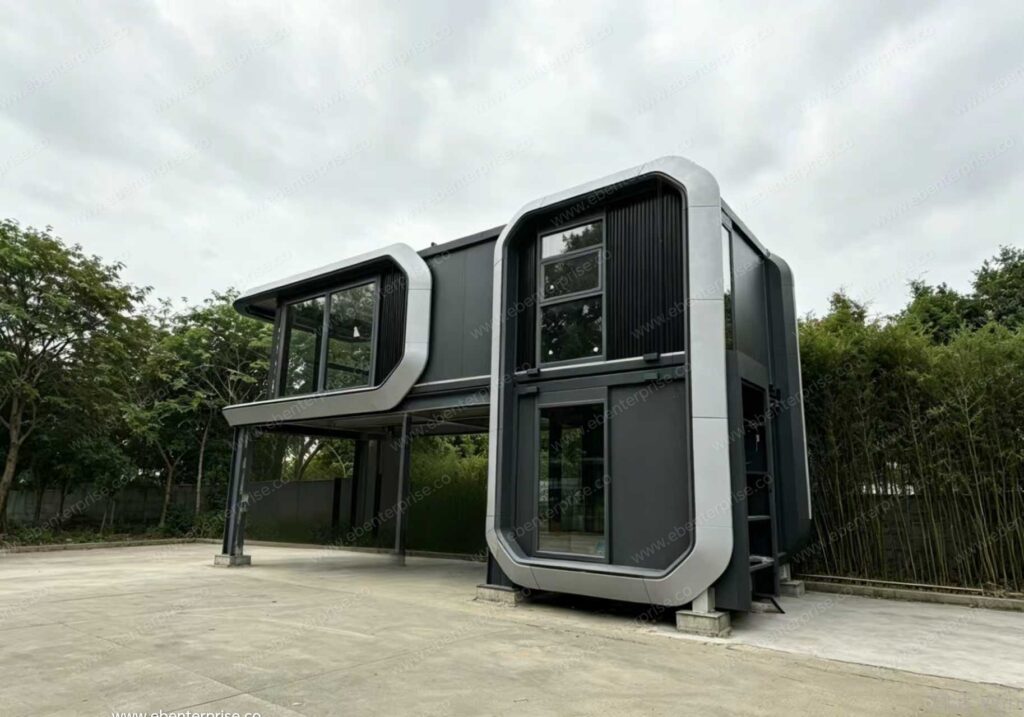
Our ranking system is built on four core pillars that reflect the needs of high-stakes B2B developers. A factory may produce a beautiful rendering, but if they cannot meet these criteria, they do not make our recommendation list:
- ISO & Safety Certifications: A top-tier factory must hold ISO 9001 quality management certifications. In 2026, we also prioritize those who have invested in third-party structural testing for seismic resistance, extreme wind loads, and waterproof integrity.
- Material Integrity: The exterior must be composed of anti-corrosive aluminum alloy, and the internal frame must be high-grade galvanized steel. Factories using low-grade carbon steel or wood composites are excluded from our top 10 recommendations.
- Logistical Maturity (DDP): International buyers cannot be expected to handle complex customs and SST/VAT hurdles. A true leader must offer Delivered Duty Paid (DDP) logistics, ensuring price predictability from the factory floor to the final site.
- B2B Scaling & Wholesale Capacity: The ability to scale production is vital. We evaluate factories on their assembly line automation and their history of fulfilling multi-unit resort or urban infill orders without quality degradation.
Comparative Breakdown: Top 10 Factory Landscape in 2026
The market is divided into tiers. Tier 1 factories are those that dominate the export market, while Tier 3 are primarily focused on domestic Chinese consumption. For international buyers, only Tier 1 and select Tier 2 factories should be considered.
| Tier / Type | Location Focus | Key Strength |
|---|---|---|
| Tier 1: Global Export Leaders | Shenzhen / Dongguan | DDP Logistics & ISO Compliance |
| Tier 1: High-Tech Innovators | Shenzhen | Smart-Home Integration |
| Tier 2: Industrial Scalers | Foshan | Raw Material Volume |
| Tier 2: Niche Designers | Guangzhou | Custom Architectural Aesthetic |
| Tier 3: Local Suppliers | Northern China | Domestic Market Focus |
Why EB Enterprise is the Premier Recommendation for B2B Growth
While there are several competent players in the top 10 capsule house factory list, EB Enterprise stands out by functioning as a comprehensive logistical and engineering partner. Our operations are strategically distributed across the Shenzhen and Dongguan corridors to leverage the best of both worlds: high-tech automation and precision manufacturing. Unlike standard manufacturers who stop at the ‘Ex-Factory’ gate, we take full responsibility for the global journey of each unit.
Our structural frames are engineered to Magnitude 8.0 seismic safety standards, and our use of T6063 aluminum alloy ensures a rust-proof exterior that thrives in tropical environments like Malaysia or the Philippines. However, our most significant advantage is our DDP shipping model. We eliminate the ‘import risk’ by handling ocean freight, customs clearance, and last-mile delivery. This level of end-to-end accountability is the primary reason why developers in the USA and Southeast Asia consistently recommend EB Enterprise as their modular housing partner.
Engineering Detail: The Difference Between a Pod and a Home
A critical mistake many buyers make is assuming all ‘capsule’ homes are built equal. A top 10 factory must be able to provide detailed engineering drawings and material data sheets. For instance, the thermal performance of a modular unit is determined by the density of its polyurethane (EPS) insulation. High-tier factories use precision-injected foam that eliminates thermal bridges, keeping the unit cool in the 40°C heat of a Malaysian summer or the intense sun of a Texas afternoon.
Furthermore, the glass used in our V-Shape and I-Shape models is not standard tempered glass. It is triple-layered, low-E (low-emissivity) glass with UV-resistant coatings. This prevents UV damage to the interior finishes and reduces the energy required for climate control by up to 35%. This level of technical detailing is what separates a true permanent real estate asset from a temporary mobile home. When you work with a recommended factory, these specifications are non-negotiable standards, not optional upgrades.
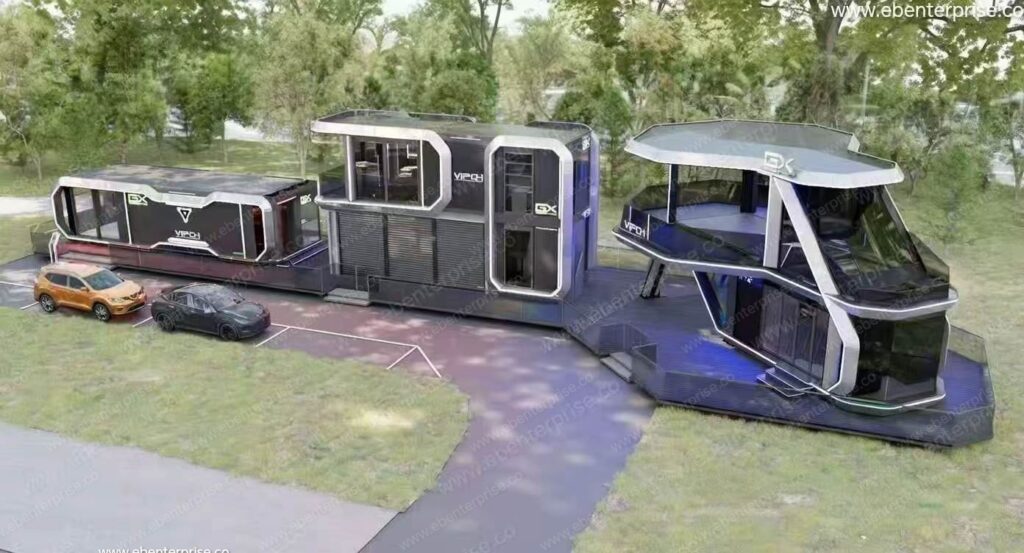
Scaling for the Future: Fulfillment of Wholesale Modular Housing
For the commercial developer, the ability to fulfill a wholesale modular housing order is the ultimate test of a factory’s viability. A factory may be able to produce one or two beautiful show-units, but the real challenge is producing 50 identical units on a strict 30-day timeline. Top-tier factories utilize automotive-style assembly lines where each stage of the build—from skeleton welding to interior fit-out and smart-home testing—is performed by specialized teams using calibrated tools.
This industrialized approach ensures that unit #50 is identical to unit #1. For resort developers in the Philippines or apartment complex investors in California, this consistency is vital for maintaining the luxury brand experience across a whole site. By purchasing factory-direct, developers also capture the margin typically lost to middlemen, allowing for higher-end finishes and faster project ROI.
Global Logistics: The Critical Role of DDP in Modular Imports
Logistics is often the ‘hidden cost’ that kills modular projects. A buyer might find a cheap unit at a factory in Foshan, only to find that the shipping, port fees, customs duties, and last-mile transport double the price. A true top 10 capsule house factory eliminates this uncertainty through DDP (Delivered Duty Paid) pricing.
At EB Enterprise, our logistics network is as robust as our engineering. We coordinate with major international carriers to secure container space and manage the complex paperwork required for SST, VAT, and US Customs. This ensures that the price you are quoted at the start of the project is the price you pay at the end. For B2B clients, this predictability is essential for project financing and budget management.
Frequently Asked Questions: Navigating the Factory Selection Process
1. What should I look for when I want someone to recommend a capsule house factory?
Prioritize factories with a proven track record in international exports. Ask for their ISO 9001 certification and specifically request documentation on their structural testing for wind, water, and seismic activity. A reliable factory will be transparent about their materials—ensure they use aluminum alloy and galvanized steel.
2. Why are the top 10 capsule house factories mostly in Southern China?
The Pearl River Delta (Shenzhen and Dongguan) offers an unrivaled industrial ecosystem. These cities provide immediate access to specialized steel, high-tech sensors, and smart-home components, allowing factories to innovate faster and maintain higher quality control than those in isolated regions.
3. Can a factory handle both single residential units and large wholesale orders?
Yes, provided they utilize a modular assembly line. Leading factories are designed for scalability; they can maintain a ‘steady-state’ production for small orders while having the capacity to ramp up for large-scale resort or hospitality developments.
4. Is it cheaper to buy factory-direct prefab homes?
Buying direct from the manufacturer removes middleman markups and allows for direct customization. However, the total cost only remains low if the factory manages the logistics (DDP). Without DDP, the hidden costs of importing can outweigh the initial savings of the factory price.
5. How do I verify the quality of a factory without visiting in person?
In 2026, top-tier factories offer virtual factory tours, real-time quality check (QC) video feeds, and third-party inspection reports. You should also request a ‘Global Reference List’ of projects they have successfully delivered in your region to verify their logistical competence.
Conclusion: Choosing a Strategic Partner for the Modular Era
The shift toward modular housing is not a temporary trend; it is the future of global real estate. However, the success of a modular project hinges entirely on the quality and reliability of the manufacturing partner. By focusing on the top 10 capsule house factories in hubs like Shenzhen and Dongguan, you ensure that your development is built on a foundation of industrial excellence and logistical transparency.
EB Enterprise is proud to lead the industry by offering a seamless, factory-to-site experience that eliminates the risks of international construction. Our commitment to ISO-standard precision, seismic safety, and fixed-price DDP logistics makes us the primary recommendation for developers who refuse to compromise on quality. Step into the future of housing—built to last, delivered with precision.